Home

Take the Leap: How Project Advance Changed My Path to Yale

A Syracuse Student’s Journey from Nottingham High School to an Ivy League Campus

by Sari Signorelli

When Martine walked onto Yale University’s campus as a freshman, she wasn’t overwhelmed by anxiety about whether she could handle college-level work. She wasn’t panicking about her first syllabus or wondering if she belonged in the same classroom as students from elite prep schools across the country. Why? Because she’d already proven to herself that she could succeed in college courses—right in her own high school, through Syracuse University’s Project Advance program (SUPA).

“I think what intimidated me the most about college was whether I would be comfortable in the academic environment, when I arrived on campus would I be able to do as well in the classroom as my peers? But I think the SU classes really allowed me to test out those waters and build academic confidence.”

More Than Just College Credit

For Martine, SUPA wasn’t just about getting a head start on college credits—though that’s certainly a valuable benefit. The real transformation happened in how these courses changed her relationship with learning itself.

Take her Creative Nonfiction class (WRT 114: Introduction to Creative Nonfiction). “That was probably my favorite class,” she recalls. “It showed me the potential for what writing can be. It taught me about writing as communication.”

Unlike typical high school assignments where you follow strict guidelines and write what you’re told, the SU writing course gave her something she hadn’t experienced before: autonomy. “We had more autonomy over the sorts of papers we wrote and the topics we decided to pursue. I think it just reignited some academic excitement.”

That writing class turned out to be more than just interesting—it became foundational to everything that came after. “The skills I gained from that class have really helped me become a stronger writer,” she says. “Pretty much in all of the work and jobs, internships, I think the skills I gained from that class have been broadly applicable.”

The Stats That Actually Mattered

Martine almost took calculus instead of statistics during her senior year—a decision that could have gone either way. “It was a slightly arbitrary decision to pick between stats or calc,” she admits. But something made her choose statistics, perhaps sensing it might be more useful for the social sciences she was interested in.

That choice paid off in ways she couldn’t have imagined. “Statistics has been tremendously helpful here [at Yale]. I’ve taken a few data science classes and also, a lot of my political science thesis, I was able to use statistical knowledge that I gained in my SU stats class.”  (MAT 221/222 Elementary Probability and Statistics I and II)

The Hidden Skills Nobody Talks About

Here’s something most people don’t tell you about college: the actual course content is only part of what you need to succeed. The other part? Learning how to learn. Learning how to advocate for yourself. Learning how to ask for help.

“Being in a college level course is a time that you really need to advocate for yourself, to be able to learn how to ask for help, use things like office hours and also lean on your peers and your classmates,” Martine points out. “Learning the skills of a psychology class or a physics class, that’s important, but also learning what are called the soft skills—skills in advocating for yourself—that’s key. And that’s something that I gained more from my SU classes than I expected.”

These aren’t skills you can learn from a textbook. You develop them by experiencing what it’s like to navigate a college course, manage your time differently, and take ownership of your education.

What Stood Out?

“I think the huge advantage of SU courses offered through Project Advance is that they are seminar‑style, with around 30 students,” Martine says. “Having that smaller environment actually made it easier for me to learn the material.”

The academic rigor, she notes, was fully comparable to the introductory courses she later took in college. What made the experience different was the format. “A lot of intro college classes are huge lectures,” she explains, “and it’s really difficult to have the time or space to discuss the topics you’re learning about.”

The Ripple Effect

Perhaps the most powerful part of Martine’s story isn’t just about her own success—it’s about how Project Advance shaped her vision for her future.

Seeing Syracuse University’s commitment to access and outreach in Syracuse city schools made a lasting impression. When she arrived at Yale, one of her first questions was: “Where is Yale involved in New Haven?” She’s spent much of her college career volunteering and working in New Haven public schools, and her career goals now center on “helping build pathways for higher education, especially people from less traditional backgrounds.”

“I think seeing how well that worked has influenced just—I’ve spent a lot of time working and also volunteering in public schools in New Haven since I’ve gotten to Yale,” she reflects. “Project Advance is a really exceptional example of a partnership that is really about access to higher education.”

Martine’s Advice

For students trying to decide whether to take SU courses through Project Advance, Martine’s advice is simple: “Just try it.”

You don’t have to have your whole future figured out. You don’t have to know for certain that you’re going to a four-year college. That’s the point. Project Advance lets you explore, experiment, and discover what excites you academically—all while earning college credit and building confidence that will serve you no matter what path you choose.

“High school is pretty prescriptive and you’re still doing all these general requirements,” Martine observes. “But I think the SUPA program allowed me to take that next step forward and explore my academic career for myself.”

Project Advance courses are available at select high schools in partnership with Syracuse University. Talk to your guidance counselor to learn which courses are offered at your school and how to enroll.

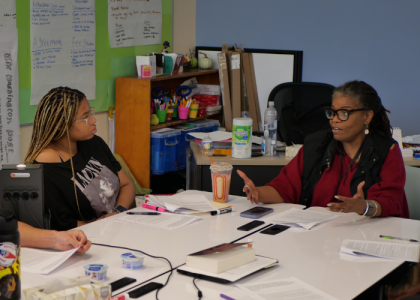
Classroom Views: SPA 201 & FRE 201

St. Mathews High School - Group

Jordan-Mathews High School, North Carolina (Pictured in Slides 1-4)
Teacher: Cynthia Brendenberg

“The SUPA students were tasked with developing an exhibit similar to one that would be seen in an art museum. We visited Nasher Museum of Art at Duke University and the students had to take a picture of something that represented their culture (in conjunction with Hispanic Heritage Month). The students then wrote a description in the languages that they speak, with their home language showing first, then their second and even third languages. We invited staff and students to a reception and the students spoke about their pictures in Spanish and English. The pictures were then on display during Hispanic Heritage Month.”

Dewitt Clinton High School, New York (Pictured in Slides 5-6)
Teacher: Kristina Schunk-Molina

“Based on our current court metrage (short video in French – le Courrier du Parc) students worked in pairs to write a 10 sentence summary of the film. Sentences were written on strips of paper. Then each pair of students swapped summaries and had to figure out the correct chronological order as quickly as possible. The fastest team to finish and get all of them correct won a croissant! Kids had a blast and did a great job. Afterwards students shared their summaries to the class. In the picture I sent you students are next to their partners holding the summaries they created! Everything was done in French!”

Pelham Memorial High School, New York (Not Pictured)
Teacher: Ariadne Livaditis

“My SUPA French students celebrated La Chandeleur, Crepe Day, on Monday, February 3rd, with our Foundations of Learning Students. These students need alternate learning standards and are a part of the special education program. This was a great day where the SUPA students got to prepare crepes, share fun French facts, and collaborate interdisciplinary with other students. The students were separated into four groups (one made the batter, one did the cooking, one did the preparing with Nutella, and one group colored). We had a great day!”


SUPA Establishes New International School Partnership

Syracuse University Project Advance (SUPA) is proud to announce a brand new partnership with Taipei FuHsing Private High School, located in Taiwan. This innovative collaboration will allow students to earn college credits while completing their secondary education, providing a significant advantage as they pursue higher education and future career opportunities.

Through this partnership, Taipei FuHsing students will have the opportunity to enroll in select Syracuse University courses through SUPA, gaining valuable exposure to university coursework and faculty. The program is designed to complement the students’ existing high school curriculum, offering a seamless transition to higher education. By earning college credits during their high school years, students can potentially reduce the time and cost associated with obtaining a bachelor’s degree.

 “SUPA is delighted to partner with Taipei FuHsing Private High School, a leading secondary school in the region, to offer students in their Bilingual Program the opportunity to engage in authentic university coursework, earn college credit, and gain confidence in their college readiness skills while experiencing a U.S. academic curriculum,” says Dr. Christina Parish, Director of Project Advance.

SUPA faculty and staff welcomed two instructors from the high school to its Summer Institute so that they could become familiar with the SU curriculum, course pedagogy, assessment practices, and campus resources. The high school currently offers General Biology I, and SU faculty will be visiting remotely this academic year with Taipei FuHsing’s Syracuse University students.

“We are excited to partner with SUPA, bringing an exciting opportunity to our high school students. Through this collaboration, students can enroll in Syracuse University courses right on our campus during their regular school day. With two adjunct faculty members from our school involved, students will experience a smooth transition and gain a valuable head start on their higher education journey,” says James Wu, Principal of Taipei FuHsing Private School.

SUPA is committed to supporting international high students’ success and access to U.S. higher education opportunities and to developing vibrant academic partnerships with interested institutions. For more information on how to become a partner school, please visit our website.

About Syracuse University Project Advance (SUPA) SUPA is one of the nation’s leading concurrent enrollment programs that offers rigorous Syracuse University courses to high school students, allowing them to earn college credit during their regular school day. With over 200 partner schools in nine states and ten countries, SUPA has over 800 certified high school instructors offering these courses to their high school students.

About Taipei FuHsing Private High School Taipei FuHsing Private High School, established in 1955, is a prestigious institution in Taipei known for its high academic standards and holistic approach to education. The school is acclaimed for its rigorous academic programs that span the arts, sciences, and technology, preparing students for higher education and future careers.

Attend a SUPA Information Session!

Interested in attending a SUPA Information Session? SUPA will be holding various Information Sessions throughout the Fall semester:

  • October 4 in Binghamton (Southern Tier Binghamton Holiday Inn)
  • October 4 in Buffalo (Buffalo Marriott at LECOM)
  • October 9 in San Diego (UC San Diego Park & Market)
  • October 11 in Albany (Albany Marriott)
  • October 11 in Los Angeles (Syracuse University in Los Angeles)
  • October 18 in Long Island (Garden City Hotel)
  • October 23 in Syracuse (Dan and Gayle D’Aniello National Veterans Resource Center- NVRC)
  • October 24 in New York City (Fairfield Inn & Suites-new York Midtown Manhattan/Penn Station
  • November 7 in Worcester (Hilton Garden)
  • November 8 in Boston (Double Tree Suites by Hilton-Hotel Boston)

These sessions will cover the basics of how concurrent enrollment works, how SUPA can help your students earn college credits, and how they can prepare for the rigor of college by engaging in high-level academics which aids in development of valuable college readiness skills.

Teachers and schools benefit from the quality professional development offered by our wonderful faculty partners at Syracuse University, and from the professional staff at Project Advance who serve students, teachers and schools year-round.

To register for an Information Session, please follow this link and click on the desired session. If you cannot attend and would like to send someone else from your school, please feel free to share this information!