SUPA News

SUPA in Action: Nottingham Students Thrive in SU Courses

by Alex Haessig

When SUPA visited the classes of longtime instructor Carol Charles at Nottingham High School, it didn’t take long to see what her students are gaining. Whether enrolled in EEE 370: Introduction to Entrepreneurship or MAR 301: Essentials of Marketing, the students in Carol’s classes share a common thread: they are walking out more prepared, more confident, and more purposeful about the road ahead.

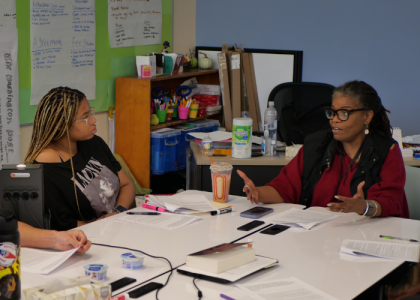
SUPA Instructor Carol Charles teaching MAR 301
Longtime SUPA Instructor, Carol Charles, at Nottingham is teaching students valuable skills through EEE 370: Introduction to Entrepreneurship and MAR 301: Essentials of Marketing.

Take Arianna Howard, a senior who has taken multiple SU courses—marketing, history, psychology, and even physics. For her, the program’s value is straightforward: “It kind of prepares me for what’s coming because I’m going to college next year.” The rigor of college-level coursework hasn’t scared her off—it’s motivated her. She credits supportive teachers with making even difficult subjects approachable, and she points to a string of college acceptances as proof that the hard work is paying off. “I see how hard I’m working, and I’m able to keep moving forward,” she says.

Read More About Arianna

For Arianna Barnes, SU’s entrepreneurship course arrived at exactly the right moment. With plans to study engineering or computer science in college alongside a business minor, she saw the course as a rare chance to pursue both interests under one roof. “This class was like, okay, we’re combining two things I love—technology and business,” she explained. Beyond content, Barnes walked away with something equally valuable: the study habits and time-management skills that college demands. Her advice to peers? “Definitely take it, but you must stay focused and make sure you’re on top of your work because it’s very easy to fall behind.”

Read More About Arianna

Then there’s Issrah Ismail, who brought something most students don’t: an actual small business. Already running a henna temporary tattoo service, Issrah didn’t enroll for an Introduction to Entrepreneurship—she enrolled for a roadmap. The course’s case studies on real entrepreneurs who faced failure before success gave her practical perspective. “It teaches you, like when you are starting a business, you have to be patient,” she said. “You can’t just expect to have a business and let it grow overnight.” Issrah also credited the course with sharpening her research skills—a habit of mind, she noted, that extends well beyond the classroom.

Read More About Issrah

Across all three profiles, a clear picture emerges. The students in these classes aren’t simply earning college credit—they’re reshaping how they think about challenge, preparation, and their own potential. SUPA bridges the gap between high school and higher education by giving students an honest preview of what college expects and the tools to meet those expectations. These Nottingham students aren’t just ready for what comes next. They’re looking forward to it.

Learn more about EEE 370: Introduction to Entrepreneurship and MAR 301: Essentials of Marketing.

Take the Leap: How Project Advance Changed My Path to Yale

A Syracuse Student’s Journey from Nottingham High School to an Ivy League Campus

by Sari Signorelli

When Martine walked onto Yale University’s campus as a freshman, she wasn’t overwhelmed by anxiety about whether she could handle college-level work. She wasn’t panicking about her first syllabus or wondering if she belonged in the same classroom as students from elite prep schools across the country. Why? Because she’d already proven to herself that she could succeed in college courses—right in her own high school, through Syracuse University’s Project Advance program (SUPA).

“I think what intimidated me the most about college was whether I would be comfortable in the academic environment, when I arrived on campus would I be able to do as well in the classroom as my peers? But I think the SU classes really allowed me to test out those waters and build academic confidence.”

More Than Just College Credit

For Martine, SUPA wasn’t just about getting a head start on college credits—though that’s certainly a valuable benefit. The real transformation happened in how these courses changed her relationship with learning itself.

Take her Creative Nonfiction class (WRT 114: Introduction to Creative Nonfiction). “That was probably my favorite class,” she recalls. “It showed me the potential for what writing can be. It taught me about writing as communication.”

Unlike typical high school assignments where you follow strict guidelines and write what you’re told, the SU writing course gave her something she hadn’t experienced before: autonomy. “We had more autonomy over the sorts of papers we wrote and the topics we decided to pursue. I think it just reignited some academic excitement.”

That writing class turned out to be more than just interesting—it became foundational to everything that came after. “The skills I gained from that class have really helped me become a stronger writer,” she says. “Pretty much in all of the work and jobs, internships, I think the skills I gained from that class have been broadly applicable.”

The Stats That Actually Mattered

Martine almost took calculus instead of statistics during her senior year—a decision that could have gone either way. “It was a slightly arbitrary decision to pick between stats or calc,” she admits. But something made her choose statistics, perhaps sensing it might be more useful for the social sciences she was interested in.

That choice paid off in ways she couldn’t have imagined. “Statistics has been tremendously helpful here [at Yale]. I’ve taken a few data science classes and also, a lot of my political science thesis, I was able to use statistical knowledge that I gained in my SU stats class.”  (MAT 221/222 Elementary Probability and Statistics I and II)

The Hidden Skills Nobody Talks About

Here’s something most people don’t tell you about college: the actual course content is only part of what you need to succeed. The other part? Learning how to learn. Learning how to advocate for yourself. Learning how to ask for help.

“Being in a college level course is a time that you really need to advocate for yourself, to be able to learn how to ask for help, use things like office hours and also lean on your peers and your classmates,” Martine points out. “Learning the skills of a psychology class or a physics class, that’s important, but also learning what are called the soft skills—skills in advocating for yourself—that’s key. And that’s something that I gained more from my SU classes than I expected.”

These aren’t skills you can learn from a textbook. You develop them by experiencing what it’s like to navigate a college course, manage your time differently, and take ownership of your education.

What Stood Out?

“I think the huge advantage of SU courses offered through Project Advance is that they are seminar‑style, with around 30 students,” Martine says. “Having that smaller environment actually made it easier for me to learn the material.”

The academic rigor, she notes, was fully comparable to the introductory courses she later took in college. What made the experience different was the format. “A lot of intro college classes are huge lectures,” she explains, “and it’s really difficult to have the time or space to discuss the topics you’re learning about.”

The Ripple Effect

Perhaps the most powerful part of Martine’s story isn’t just about her own success—it’s about how Project Advance shaped her vision for her future.

Seeing Syracuse University’s commitment to access and outreach in Syracuse city schools made a lasting impression. When she arrived at Yale, one of her first questions was: “Where is Yale involved in New Haven?” She’s spent much of her college career volunteering and working in New Haven public schools, and her career goals now center on “helping build pathways for higher education, especially people from less traditional backgrounds.”

“I think seeing how well that worked has influenced just—I’ve spent a lot of time working and also volunteering in public schools in New Haven since I’ve gotten to Yale,” she reflects. “Project Advance is a really exceptional example of a partnership that is really about access to higher education.”

Martine’s Advice

For students trying to decide whether to take SU courses through Project Advance, Martine’s advice is simple: “Just try it.”

You don’t have to have your whole future figured out. You don’t have to know for certain that you’re going to a four-year college. That’s the point. Project Advance lets you explore, experiment, and discover what excites you academically—all while earning college credit and building confidence that will serve you no matter what path you choose.

“High school is pretty prescriptive and you’re still doing all these general requirements,” Martine observes. “But I think the SUPA program allowed me to take that next step forward and explore my academic career for myself.”

Project Advance courses are available at select high schools in partnership with Syracuse University. Talk to your guidance counselor to learn which courses are offered at your school and how to enroll.

View and Download Registration Materials

Registration Materials (Spring 2026)

  • Spanish Translation (coming soon)

SUPA Guides (2025-26)

Forms and Additional Information

Important Dates (Spring 2026)

Registration StepsDates and Deadlines
Online Registration OpensJanuary 12, 2026
Online Registration Closes & Tuition Assistance Application DeadlineMarch 2, 2026
Tuition Payment DeadlineMarch 23, 2026
Drop DeadlineApril 10, 2026
Withdrawal DeadlineMay 8, 2026
Official Syracuse University Grades PostedJune 18, 2026

SUPA Instructor Scott Rubins Named National High School Forensic Science Educator of the Year

Syracuse University Project Advance (SUPA) proudly celebrates Scott Rubins, longtime SUPA Forensic Science instructor at New Rochelle High School, who has been named the 2025 National High School Forensic Science Educator of the Year by the Consortium of Forensic Science Organizations (CFSO).

This prestigious national award honors Rubins for his innovation in teaching, dedication to student learning, and the powerful ways he connects forensic science with real-world experience.

For nearly three decades, Rubins has transformed forensic science education into something far beyond textbooks and lectures. His classroom functions like a professional crime lab—students process evidence, analyze mock crime scenes, and even take their findings to “court” in simulated trials. Each year, his Mock Crime Scene Final Exam, now in its 26th year, brings together more than 140 students in an immersive investigation and presentation experience.

“After 29 years of teaching forensic science—25 of those as a SUPA instructor—this feels like a meaningful recognition of everything I’ve worked toward professionally,” Rubins said. “On a personal level, it’s an incredible feeling. ‘Wow’ is the best way to describe it. I’m so grateful to SUPA for sharing this opportunity and for being such an important part of my journey.”

David Tate, Associate Director of Syracuse University Project Advance and Forensics Course Administrator, said Rubins exemplifies the best of what concurrent enrollment can achieve.

“Scott has been an outstanding partner in our mission to bring the rigor of college-level learning directly into high schools for more than twenty years,” Tate said. “What sets him apart is how he combines real-world forensic experience with exceptional teaching—his students don’t just learn about forensic science; they practice it. This award is a fitting recognition of his impact on students and on the field.”

Beyond the recognition, Rubins remains focused on what matters most: empowering students to see their own potential. Through his connections with professionals in forensic labs, law enforcement, and research, he’s introduced students to real-world cases, scientific papers, and experts who bring the field to life. Many of his former students have gone on to careers in forensic science and law enforcement, some even returning to mentor the next generation in his classroom.

Rubins credits his experience with Syracuse University Project Advance as a transformative influence on his teaching.

“Being part of SUPA has allowed me to move beyond the usual classroom limits,” he said. “It’s pushed me to challenge my students in ways I never thought possible and helped them realize they’re capable of more than they imagined. It has truly made me a better teacher.”

Dr. Christina Parish, Director of Syracuse University Project Advance, said Rubins’ achievement reflects both his individual excellence and the collaborative spirit at the heart of SUPA.

“This prestigious national award reflects the exceptional caliber of educators SUPA is privileged to partner with,” Parish said. “Scott’s teaching is a shining example of how our instructors’ creativity, expertise, and dedication impact students. His success also highlights the unique collaboration between our campus faculty and SUPA teachers, which allows us to offer authentic, college learning experiences in high schools across the country.”

Rubins’ recognition by the CFSO is a testament to his passion, creativity, and lasting impact as an educator. His dedication exemplifies the kind of excellence that makes SUPA’s network of instructors so extraordinary — professionals who bring real-world expertise, innovation, and care into their classrooms every day.

Article by Alex Haessig

How Syracuse University Courses in High School Change Lives: JC’s Story

When high school students are encouraged by educators to enroll in Syracuse University courses through Project Advance, the impact goes far beyond earning college credits—it can change lives. JC Alejaldre, now a professor at Columbia University’s School of Public Health and a leader in hospital operations at NewYork-Presbyterian, attributes much of his academic and professional journey to the SU courses (MAT 221-222) he took at Port Chester High School through Syracuse University Project Advance (SUPA).

Early Exposure to College-Level Work

JC recalled, “I took SU stats in high school. I was excited because statistics is foundational to any science curriculum—I knew I needed it. Having those credits let me start higher-level science classes sooner, which only deepened my love and passion for learning.”

Breaking Barriers and Providing Opportunity

For JC, the opportunity to take SU courses through Project Advance was especially significant. Raised by a single mother college seemed out of reach. “College was something that not only couldn’t I grasp, but couldn’t afford,” he said. “SUPA put into reality for me that I could do college level work and invigorated my mom and I to really think about college as a possibility”

Building Confidence and Self-Belief

JC said the benefits extended beyond the financial. SUPA gave JC the confidence to see himself as a college student. “It made college feel real for me. I could do college-level work while still in high school. It was empowering, as a 16-year-old, to realize, wow, I can do this.”

That confidence was especially vital when he faced discouragement. JC’s high school guidance counselor once said that college was impossible for him: “They looked at my mom’s taxes and told us we’d never afford college. But I already knew I could succeed, because I had already done college work.”

Greater Flexibility and Discovering a Passion

Earning SU credits also gave JC more flexibility in college. “In a strict pre-med curriculum, having statistics credits already gave me some breathing room. That extra space let me take electives earlier—and that’s how I discovered public health, which changed my career.”

The Transformative Power of Early College Experience

Looking back, JC credits these SU courses taken through Project Advance as a turning point in his life: “It completely changed my high school experience and everything that followed. The earlier you step in, the greater the impact. That was certainly true for me.”

He urges educators to view SU courses as tools for empowerment. “College courses in high school can transform the way you see the subject—and yourself. That sense of growth made me believe I can do this. I’ve done it before, and I can do it again.”

For students like JC, SU courses are more than credits earned—they can change the course of a whole future.

Article by Sari Signorelli

College Ready with Syracuse University Project Advance

by Sari Signorelli

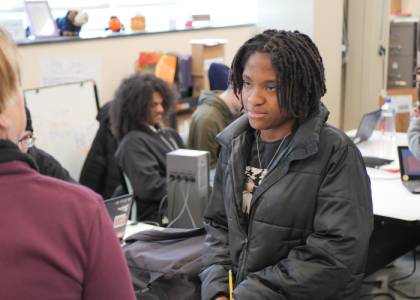
For Arianna Howard, a senior at Nottingham High School, taking Syracuse University courses through the SUPA program has been transformative—both in preparing her for college and opening doors to higher education opportunities.

“I feel like it’s a good experience and it helps with the college feel,” Arianna explains. “It kind of prepares me for what’s coming because I’m going to college next year.”

Nottingham student, Arianna Howard
Nottingham High senior Arianna Howard found confidence and motivation through Syracuse University’s SUPA program. “It kind of prepares me for what’s coming,” she says, encouraging other students to challenge themselves with the SU courses and lean on supportive teachers.

The preparation goes beyond just familiarity with college work. Arianna has taken multiple SU courses through SUPA, including marketing, history, psychology, and physics, giving her what she calls “a head start” on the material she’ll encounter in college. Even when courses prove challenging—like physics, which she admits isn’t her strength—she’s found the experience valuable. “My teacher is very helpful to me, and it definitely is making it better and fun,” she says.

Arianna’s hard work is paying off. She has been accepted to multiple colleges and believes taking Syracuse University courses played a role in her success. “I definitely think so,” she says. “Even though the courses may be challenging, I see how hard I’m working, and I’m able to keep moving forward.”

The acceptances have been affirming. “It’s like nice to see all the acceptances coming in. I’m like, wow, people want me!”

For students considering SU courses through SUPA, Arianna’s advice is clear: “Challenge yourself even if you know you’re not good at the course, because we have such amazing teachers here that will help you and provide for you when needed.”

Nottingham Student Finds Perfect Blend in SU Entrepreneurship Course

by Sari Signorelli

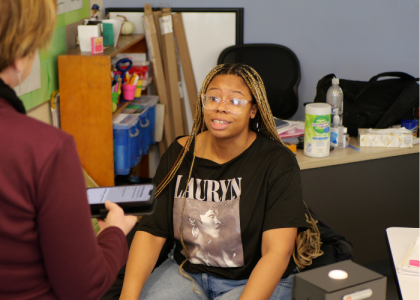
For Arianna Barnes, a student at Nottingham High School, Syracuse University’s entrepreneurship course offered through Project Advance checked all the boxes. Planning to study engineering, software development, or computer science in college with a business minor, Arianna saw the SU course as an ideal opportunity to explore both passions simultaneously.

“This class was like, okay, we’re combining two things I love, technology and business,” she explained.

Nottingham student, Arianna Barnes
Nottingham High School student Arianna Barnes says Syracuse University’s entrepreneurship course let her combine her passion for technology and business while preparing for college academics.

Beyond learning the mechanics of running a business, Arianna values how the SU courses prepare students for college-level work. “They just give you an understanding what college classes will be like and just preparing you for college in general,” she said.

Her advice for students considering taking SU courses through Project Advance? Take the leap but be ready to commit. “Definitely take it, but you must stay focused and make sure you’re on top of your work because it’s very easy to fall behind.”

The experience has taught Arianna more than entrepreneurship—she’s developed crucial study skills and learned to avoid procrastination, lessons that will serve her well in college and beyond.

High School Entrepreneur Finds Real-World Value in SU courses offered through Project Advance

by Sari Signorelli

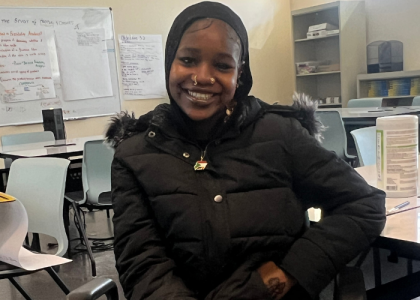
Issrah Ismail didn’t enroll in Syracuse University’s Entrepreneurship course just to learn the basics—she came in as a business owner, already running her own henna temporary tattoo service and looking to grow it intentionally. “I already got my small business right now and I feel like if I’m in this class it’s going to teach me a lot—what to do and what not to do,” she said, describing why the course mattered not as theory, but as guidance she could use right away.

This intersection of real-world application and academic learning exemplifies the unique value that the SU Entrepreneurship course brings to high school students.

Nottinham student, Issrah Ismail
Already a business owner, Issrah Ismail turns classroom learning into real-world growth through Syracuse University coursework.

Learning That Translates Beyond the Classroom

For Issrah, the course content resonated precisely because it could be applied immediately. The curriculum’s focus on case studies proved particularly valuable, exposing students to the journeys of entrepreneurs who experienced significant failures before achieving success. These narratives provided more than inspiration—they offered practical perspective on the realities of business ownership.

The lessons extended to mindset development as well. “It teaches you, like when you are starting a business, you have to be patient,” Issrah noted. “You can’t just expect to have a business and let it grow overnight. It takes a lot of time.”

This understanding of sustainable growth and realistic expectations represents exactly the kind of mature thinking we hope to cultivate through SU courses offered through Project Advance—thinking that serves students whether they pursue entrepreneurship, traditional careers, or further education.

Skill Development That Compounds

Beyond content knowledge, Issrah highlighted a critical skill that the course helped develop: research capability. “Do a lot of research, look into it before just doing stuff,” Issrah said when asked about learning skills gained from the class.

This emphasis on thorough investigation before action represents a transferable skill that will serve students across disciplines and life decisions. Issrah noted that these research skills extended “outside of this class too,” demonstrating how taking the SU course creates habits of mind that persist beyond the semester.

Building College-Ready Students

Project Advance gives students a genuine taste of college course expectations and workloads. When asked about the demands of the Entrepreneurship course, Issrah’s response was simple but revealing: “It’s worth it.”

That perspective—understanding that meaningful learning takes effort and embracing the challenge—is exactly what prepares students for college success. They learn not just course content, but the self-discipline and resilience that college demands.

A Strong Endorsement

When asked if she would be recommending the course to other students, Issrah didn’t hesitate: “Yes, I will. Especially to other people that have small businesses or want to get into the business field. I feel like this is a great class to have.”

Issrah’s experience highlights the value of giving motivated students early access to rigorous, relevant college coursework. Through Project Advance, students gain practical skills, confidence, and direction that extend beyond the classroom. Expanding opportunities like these ensures more students graduate ready to apply what they learn and take meaningful steps toward their future.